
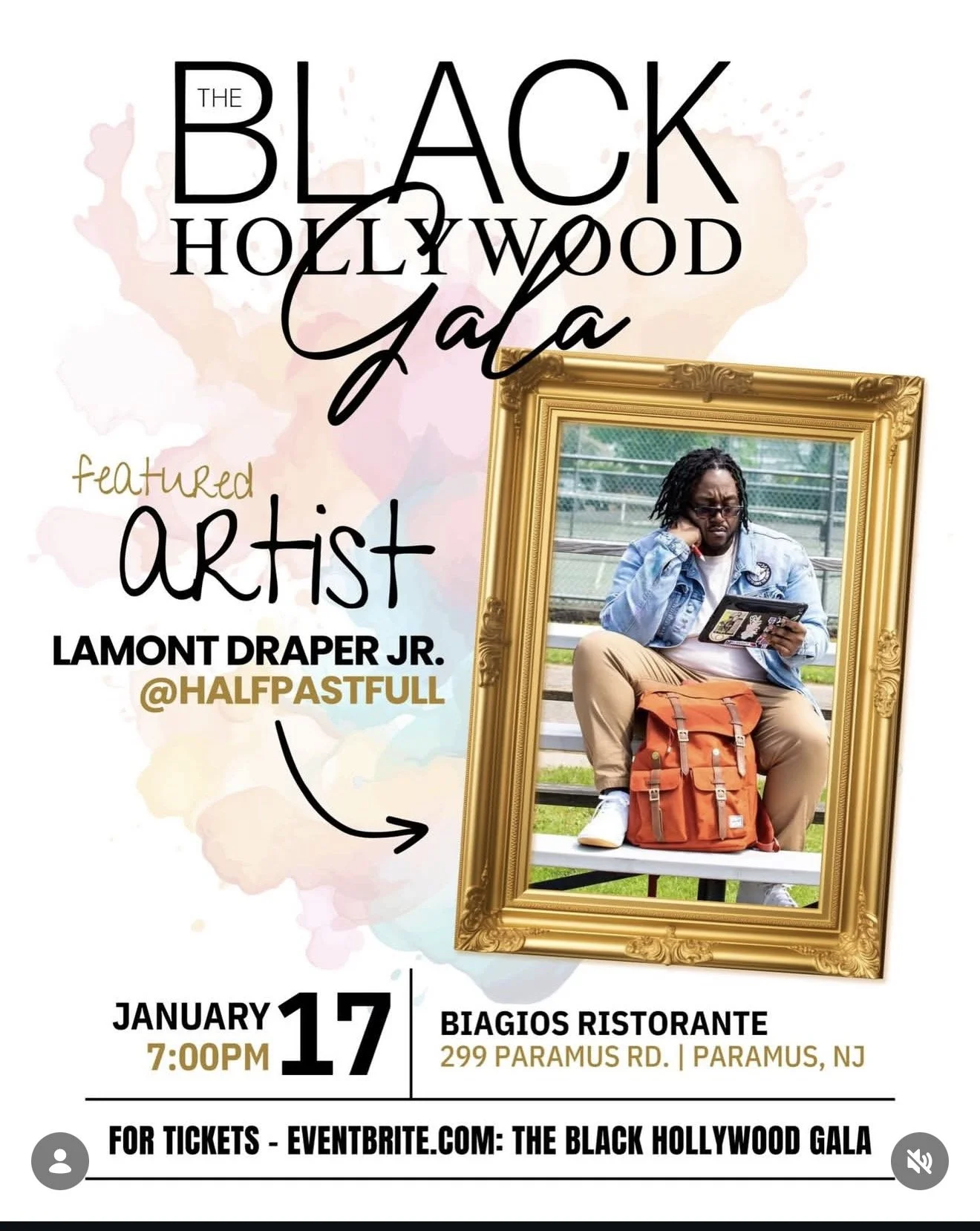
01.17.2026
A year away from the art scene has a way of clarifying things. Stepping back gave me the space to slow down, strip everything to the essentials, and focus on the work beneath the work—developing core skills, sharpening the ones that had dulled with time, and breaking habits that no longer served my growth. It wasn’t glamorous or public, but it was necessary. In the quiet, I rebuilt my foundation, reconnected with curiosity, and learned to approach my practice with more intention.
Now, after months of refining, experimenting, and reconnecting with people and ideas through new networks, it feels like the right moment to return. Not to pick up where I left off, but to move forward with clearer direction and renewed momentum. This next chapter isn’t about catching up—it’s about stepping back into the swing of things with purpose, confidence, and a deeper understanding of why I make art in the first place.
I Will Not
〰️
I Will Not 〰️
LOSE !
〰️
LOSE ! 〰️
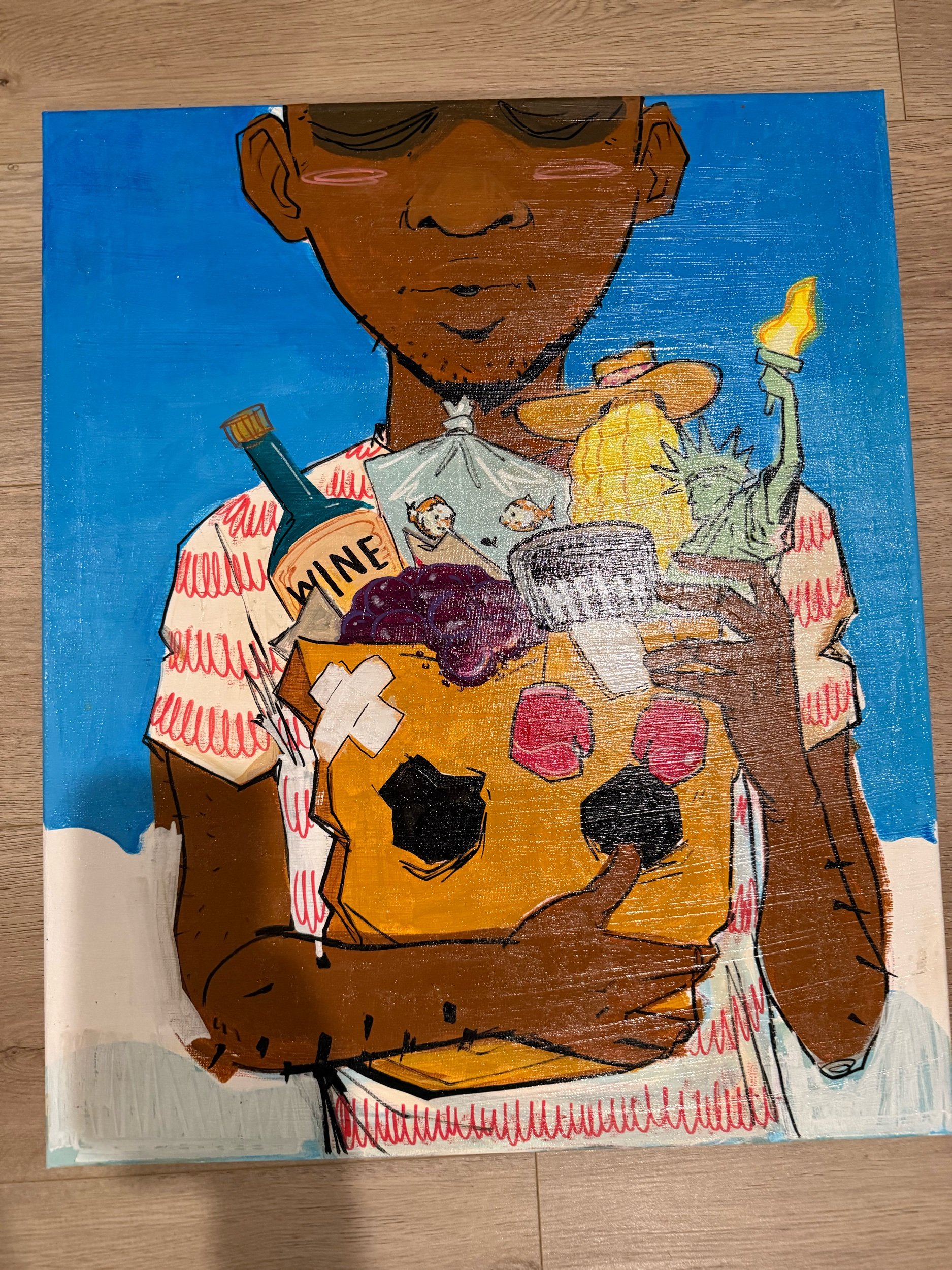
20 x 24
Acrylic on Canvas
A man found himself leaving the store with all the essential items he thought he’d ever need—at least for the night. He’d scraped together his last quarters, unrolled nickels into a little change from even littler cents, and still had enough left over to buy his growing boy a toy or two.
That’s when he noticed something was off.
Out in the clear blue, he froze—dropping his bag of essentials in awe as he looked up at something straight out of a George Orwell novel. His mind raced, but landed only on Animal Farm.
All the man could manage to mutter was:
*F#k.
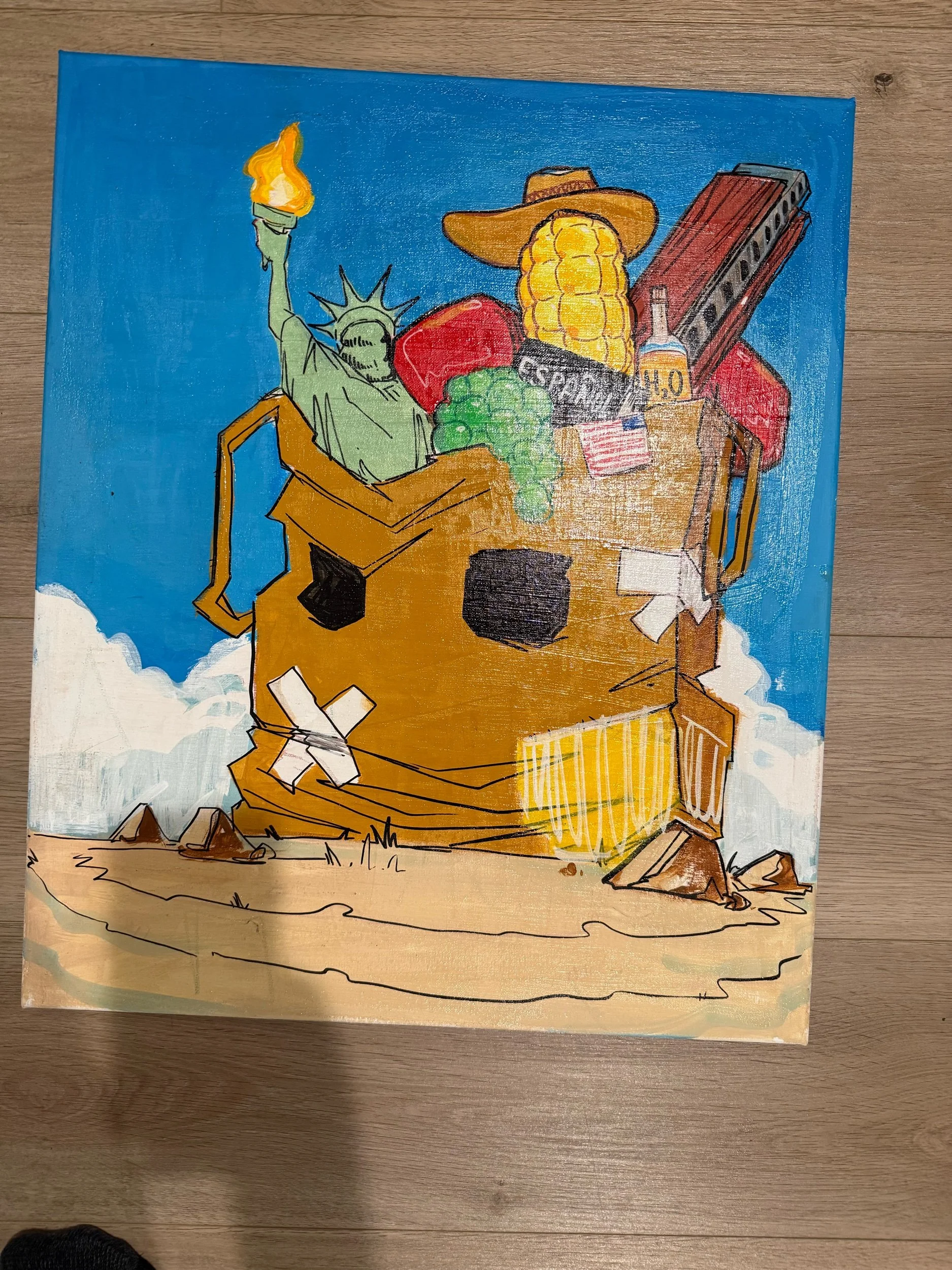
20 x 24
acrylic on canvas
The man left the store with a thin plastic bag biting into his fingers, stretched white from the weight of what little he could afford. Inside it lived everything he thought he needed to survive the night—cheap calories, stale comfort, necessity pretending to be choice. He’d emptied his pockets for it. Last quarters. Rolled nickels. Pennies counted twice, then counted again. Still, somehow, there had been just enough left to buy his growing boy a small, plastic promise that would break before morning.
The bag felt heavier than it should have.
He stopped. The sky shifted. Something changed—though he couldn’t say what. His grip loosened. The bag slipped free and split when it hit the concrete, coughing its contents across the ground. Thin, exposed, useless. Everything laid bare. Everything he had.
He stared at it, knowing without looking up that none of it mattered anymore.
All that planning. All that scraping. All that weight.
All for a night.
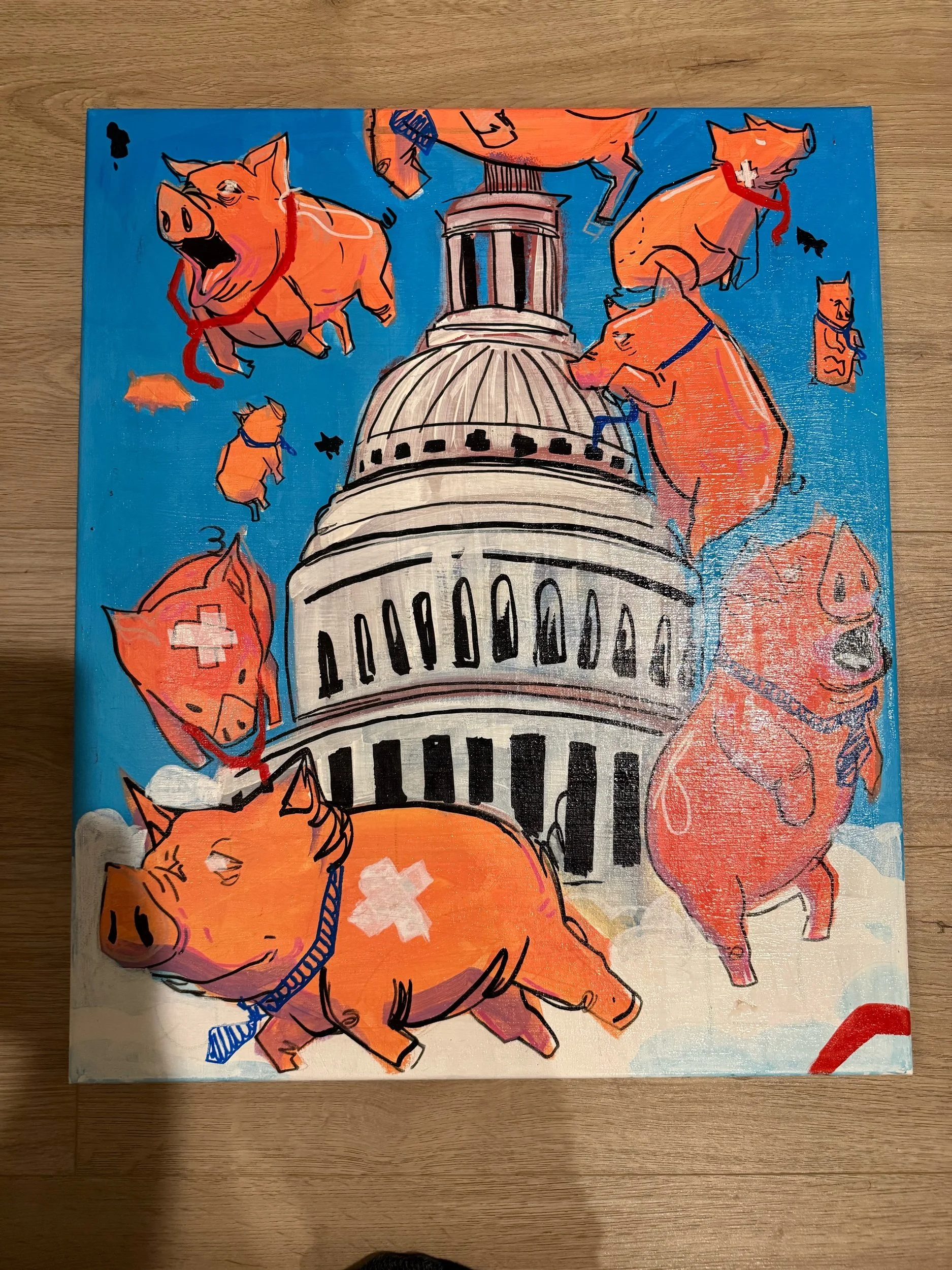
20 x 24
Acrylic on Canvas
In Animal Farm, the pigs never seize power all at once. They manage resources, language, and memory first. In 2026, the symbolism feels less allegorical and more procedural.
The pigs are no longer just rulers—they are systems. Institutions that speak in simplified slogans while rewriting the rules quietly at night. Commandments still exist, but they are updated constantly, softened, optimized, buried in fine print or algorithmic fog. What was once forbidden is now “necessary.” What was once equal is now “equitable.” The wall still stands, but no one remembers what was written on it yesterday.
The other animals are not ignorant—they’re exhausted. They work longer hours for shrinking rations, told repeatedly that scarcity is temporary and sacrifice is patriotic. Boxer’s mantra, “I will work harder,” echoes today as hustle culture, productivity metrics, and survival dressed up as virtue. When he collapses, the cart still comes. It just looks cleaner now.
The sheep have evolved too. They don’t bleat in unison anymore—they retweet, repost, repeat. Outrage cycles replace thought. Noise replaces memory. By the time a contradiction is noticed, it’s already drowned out by the next slogan.
And the humans? They never really left. They just changed clothes. Corporate interests, political elites, and media power blur together at the edges of the farm, indistinguishable from the pigs who swore they were different. From a distance, it’s impossible to tell who’s who anymore.
In 2026, Animal Farm isn’t about a revolution gone wrong—it’s about a system that no longer needs violence to maintain control. Comfort, distraction, and managed fear do the work instead. The farm still promises safety. Still promises progress. Still promises tomorrow will be better.
But the bag keeps getting lighter.
And the rules keep changing.
About this collection..
We’re living in wild times. and I mean literally wild.. In Animal Farm, control is maintained not just through force, but through selective enforcement. Rules exist, but they are applied unevenly. Some animals are watched more closely. Some are punished faster. Some are always assumed guilty before they speak. In today’s political climate, that imbalance feels familiar—especially when viewed through the lens of immigration enforcement and the lived realities of Black and Brown communities.
ICE functions, symbolically, like the farm’s dogs: trained, empowered, and unleashed in the name of “order.” They don’t write the rules, but they enforce them with teeth. Their presence alone reshapes behavior—fear becomes routine, silence becomes survival. On the farm, animals learn quickly that visibility is dangerous. In real life, Black and Brown bodies are often hyper-visible to authority and invisible to protection.
What Animal Farm captures—and what feels especially relevant now—is how language launders cruelty. Raids become “operations.” Detentions become “processing.” Families torn apart are reduced to statistics. Just as the pigs revise the commandments to justify each escalation, modern systems revise terminology to make violence administrative instead of moral. If it’s policy, it can’t be cruelty. If it’s legal, it can’t be wrong.
The tragedy is that the animals are told this is all for their safety. That scarcity, surveillance, and suffering are necessary to preserve the farm. In the current climate, Black and Brown communities are often framed as threats to stability rather than people deserving of it. The farm needs a problem to point at—someone to blame when resources shrink and promises fail.
And like in Orwell’s world, exhaustion becomes a tool. When survival takes all your energy, resistance feels like a luxury. Boxer doesn’t question the system because he’s too busy holding it up. Today, many are forced into the same position—working harder under systems that quietly devalue their lives, told that compliance is the price of belonging.
By the end of Animal Farm, the animals can no longer tell pigs from humans. That’s the most unsettling part. Power no longer pretends to be different—it just asks to be accepted. In the current political moment, the danger isn’t only in overt cruelty, but in how normalized it has become, especially when it falls on the same bodies again and again.
The farm still claims it’s protecting itself.
The rules still change.
And Black and Brown lives are still asked to carry the cost.